The essential takeaway: Whether opting for a convivial small group or an exclusive private tour, exploring Provence wines offers a genuine connection from Aix to Cannes. This immersive experience goes beyond tasting, revealing the stories behind organic vineyards and breathtaking landscapes like Sainte-Victoire. Expert guides unlock these hidden gems, ensuring a truly authentic discovery of the region’s rich terroir.
Do you crave a meaningful break from the daily digital noise to reconnect with the earth and experience a moment of pure, unfiltered authenticity away from the tourist crowds? Choosing the perfect wine tours provence itinerary is your gateway to slowing down, meeting the passionate families behind the labels, and savoring the local art of living. We unveil the secrets to finding those hidden gem estates that promise not just a glass of rosé, but a truly human story and a sensory awakening that you will be proud to share.
Choosing Your Provence Wine Tour: Small Group vs. Private Experience
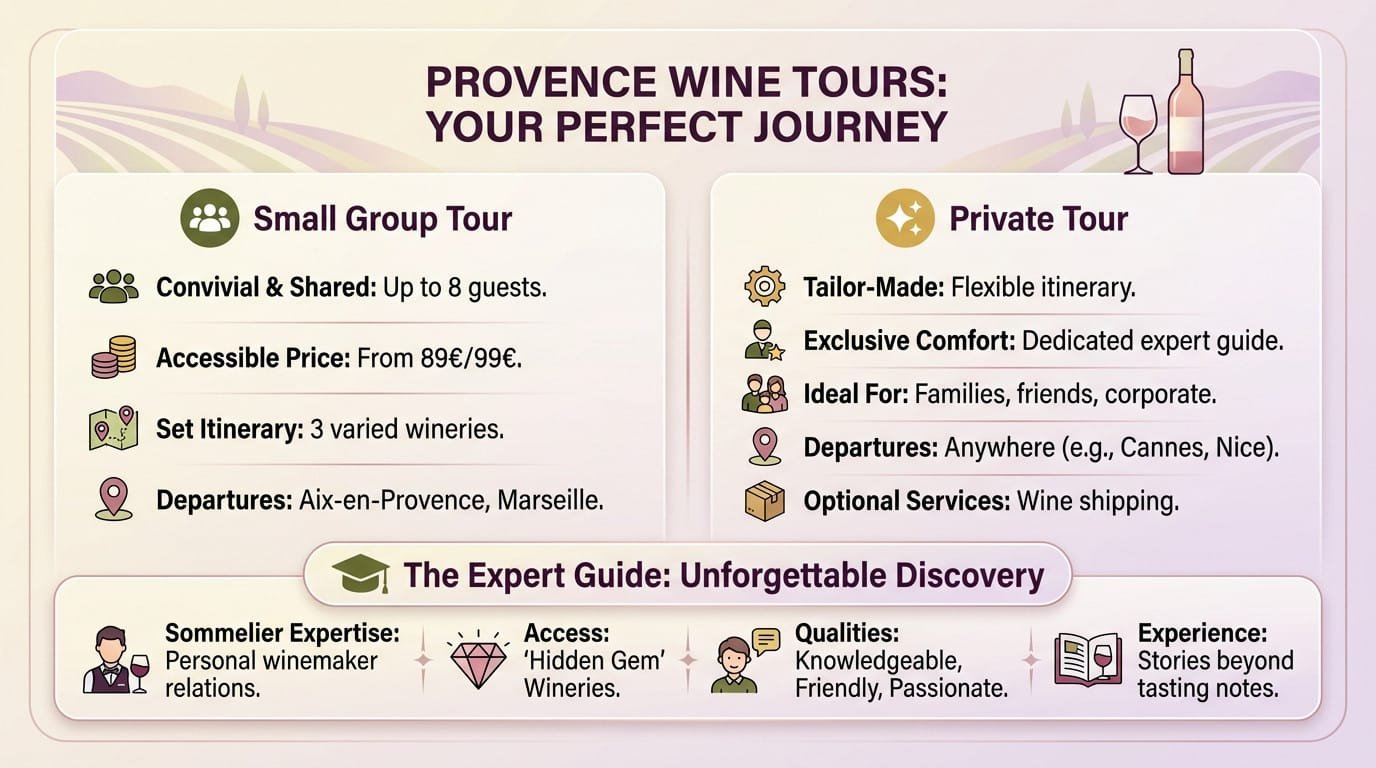 choice between small group and private wine tours.”>
The Small Group Tour: Conviviality and Discovery
You want to explore the region without breaking the bank or planning every detail. These tours cap at eight people, making them perfect for solo travelers or couples wanting a shared adventure. It is an accessible option starting from Aix-en-Provence or Marseille, with prices often beginning at just 89€ or 99€.
Don’t worry about feeling lost in a crowd; the vibe remains intimate enough to ask every question you have. You connect with other enthusiasts while learning about wine in a totally relaxed atmosphere. It is social, fun, and educational.
These routes are fixed but curated by experts to show you the best variety available. You typically visit three distinct wine estates, giving you a genuine snapshot of the region’s terroir without the stress of driving.
The Private Tour: A Tailor-Made Journey into Provence Wines
If you hate compromise, this is your best move for a truly unique day. You control the schedule, perhaps targeting specific appellations like Châteauneuf-du-Pape or focusing entirely on organic producers. It is the ultimate bespoke experience designed around your specific palate.
You get total exclusivity and the luxury of a dedicated vehicle for your party. Your expert guide focuses one hundred percent on your group’s interests. This works perfectly for families, close friends, or corporate retreats needing privacy.
Logistics become effortless with pickups available from almost anywhere, including Cannes or Nice directly to the vines. They even handle shipping your favorite bottles home, so you don’t have to carry heavy cases internationally.
What Really Makes a Great Tour: The Guide
Forget the fancy minivan; the secret sauce of any excursion is the human element. A truly great tour relies on an expert in wine, often a trained sommelier, who holds real friendships with the local growers. They bridge the gap between you and the winemaker.
That insider access gets you into “hidden gem wineries” off the main tourist roads. You meet families who have farmed the land for generations. It transforms a standard tasting into a genuine connection with the local culture.
Reviews consistently describe these pros as “knowledgeable,” “friendly,” and “passionate” for good reason. They don’t just pour wine; they share the history and soul of the region, making the day unforgettable.
Your Provence Wine Tour Departure Points: A Strategic Choice
Now that you have a sense of the experience you want, the next question is: where do you start? The city you choose as your base will directly dictate which vineyards you can actually reach.
Aix-en-Provence: The Classic Gateway To Côtes de Provence
Aix-en-Provence stands out as the most central hub for wine tours provence. It acts as the logical door to open if you want to explore the Coteaux d’Aix-en-Provence and the specific Côtes de Provence Sainte Victoire areas.
The landscape here is exactly what you see on postcards: the imposing Sainte-Victoire mountain and, in season, endless lavender fields. You are in the heart of the land dedicated to iconic rosé.
This city is a major hub for small group tours, so you have plenty of options. It is the easy, efficient choice for a first introduction to Provence wines.
Avignon: Exploring The Renowned Rhône Valley
Let’s shift the scenery. Starting your journey from Avignon points you toward a totally different prestigious region: the Rhône Valley. It is the absolute go-to departure point for anyone who favors powerful reds over summer rosés.
You get access to mythical appellations like Châteauneuf-du-Pape, Gigondas, and Vacqueyras. While they do produce some white and rosé, these tours focus heavily on structured red wines that define the area.
Excursions to the Luberon (AOP Luberon) are also possible from here. These trips offer a mix of different landscapes and wines, often including stops in those famous hilltop villages.
Marseille: Coastal Vibes And Unique Terroirs
Marseille mixes the energy of a large port city with access to rare vineyards. It is the ideal launchpad to hit the Cassis and Bandol appellations. You get a coastal influence here that changes the wine profile entirely.
The wines of Cassis are specific, known for dry, mineral whites that pair perfectly with seafood. The drive often includes views of the Calanques, which is a massive bonus to the trip.
Tours from Marseille often include visits to picturesque villages like Le Castellet. It offers a complete experience that balances the sea, the vines, and the local heritage.
Cannes: The Riviera Starting Point For Eastern Provence
Let’s address the “Cannes Wine Tour” subject directly. Cannes, though further east, is an excellent starting point for private tours and custom experiences. It is the option for those staying on the Côte d’Azur who want something exclusive.
You can access the eastern Var vineyards (Côtes de Provence) and the confidential Bellet appellation, located on the heights of Nice. These are spots the average tourist usually misses.
Starting from Cannes allows you to discover a different side of wine Provence. You visit estates that often overlook the Mediterranean, offering a view you simply don’t get inland.
What to Expect From Your Day: A Typical Provence Wine Tour Itinerary
So, concretely, how does a tasting day actually unfold? While every tour has its own unique flavor, there is a consistent thread that guarantees a rich, well-paced experience that keeps you engaged from start to finish.
The Morning: Departure and First Vineyard Immersion
Your guide picks you up directly from your hotel or a central meeting point in a comfortable, air-conditioned van. The drive isn’t just transit; it’s your first introduction to the region’s history and the complex classification of French wines. You get the context before you even see a grape.
You arrive at the first stop, usually a charming family-owned estate that feels miles away from the city noise. The visit kicks off with a walk through the vines, where the guide breaks down the specific terroir and grape varieties. It connects you to the soil immediately.
Next, you head inside to discover the cellars, understanding the winemaking and aging process firsthand. The focus here is on the sensory experience, not a dry, overly technical lecture that puts you to sleep. You see exactly how the magic happens.
The Tasting Session: Learning to Appreciate Provence Wines
This is the key moment you have been waiting for. The guide teaches you the basics: observing the color, smelling the aromas, and finally tasting. The goal is giving you the keys to appreciate wine, not turning you into an arrogant oenologist.
You won’t just drink pink; the variety is surprising. While you will taste a selection of signature rosés, you also explore crisp whites and bold reds to showcase the estate’s full palette. It challenges what you think you know about the region.
- Rosé de Provence: Fresh, fruity, the star of the region.
- Blanc de Provence: Often based on Rolle/Vermentino, lively and aromatic.
- Rouge de Provence: Structured, spicy, notably in Bandol.
Lunch and Afternoon: Exploring More Terroirs and Villages
Depending on the specific tour, lunch is either free time in a picturesque village like Cassis or Le Castellet, or an organized picnic right in the vineyards. It’s a moment for genuine relaxation and exchange with the group. You get to breathe and soak in the atmosphere.
The afternoon is dedicated to visiting one or two other estates to mix things up. The idea is showing diversity: perhaps an organic farm, a cooperative cellar, or a more modern producer. You see different philosophies in action.
This day isn’t a race against the clock. The pace is designed for enjoying every instant, including stops to admire breathtaking viewpoints, like the panorama over Mont Sainte Victoire or the cliffs of Cassis. It’s about making memories, not just checking boxes.
A Focus on Provence’s Key Wine Regions and Their Specialties
Every Provence appellation boasts its own distinct personality, believe me. To ensure you don’t waste time on a tour that doesn’t fit your palate, here is a breakdown of the regions and the specific wines defining them.
Côtes de Provence: The Heartland of Rosé
Côtes de Provence isn’t just a name; it is the region’s massive engine. This is the undisputed global epicenter of rosé production. Expect the style to be consistently dry, incredibly pale, and packed with aromatic punch.
Don’t ignore the sub-appellations, because they add serious nuance to the glass. Sainte-Victoire offers far more structured rosés, while Fréjus brings a distinct character influenced by its volcanic soil.
While pink dominates, you are missing out if you ignore the rest. The area produces excellent reds based on Syrah and Mourvèdre, plus zesty whites.
Bandol and Cassis: Coastal Gems With Strong Identities
These two coastal neighbors couldn’t be more different. Bandol is the absolute kingdom of Mourvèdre, producing powerful, long-aging red wines that rank among Provence’s best. Even their rosé carries a reputation for serious complexity.
Conversely, Cassis dedicates itself almost exclusively to white wines. Its limestone terroir, facing the Mediterranean, yields saline and mineral bottles that are the ultimate companions for a local bouillabaisse.
Taking a tour in this zone, often departing from Marseille, provides a striking contrast. You get the raw power of Bandol reds right alongside the delicate finesse of Cassis whites.
Châteauneuf-du-Pape: A Legend in the Southern Rhône
For anyone serious about grand reds, this excursion from Avignon is non-negotiable. It is a historic appellation, famous worldwide for allowing thirteen different grape varieties in its blends.
The wines are rich and complex, exploding with notes of black fruits, spices, and wild garrigue. You will see the famous galets roulés stones that store heat to ripen the grapes.
Keep an eye out for white Châteauneuf-du-Pape, too. It is much rarer, but highly sought after by collectors for its incredible richness and surprising aging potential.
Coteaux d’Aix-en-Provence and Les Baux: Diversity Around Aix
Coteaux d’Aix-en-Provence is a diverse region producing all three colors, though fresh, elegant rosés dominate the volume. This appellation serves as the primary playground for most tours starting from Aix.
Just next door, Les Baux-de-Provence stands out as a true bastion of organic and biodynamic viticulture. Here, the reds and rosés have real character and grit.
- Coteaux d’Aix: Incredible variety of styles and easy accessibility.
- Les Baux-de-Provence: Strong commitment to organic farming and spectacular Alpilles landscapes.
Comparing the Best Provence Wine Tour Options
Choosing the wrong base for your wine tour is easier than you think, and it often leads to unnecessary disappointment. You do not want to find yourself stuck in a region famous for heavy, tannic reds when you were actually dreaming of sipping crisp, mineral whites by the sea. To save you from that frustration, I have broken down the logistics. This comparison ensures you match your personal travel style with the perfect vineyard experience without wasting hours on research.
Your At-a-Glance Guide to Provence Wine Tours
Here is the breakdown of the top departure points. I have highlighted exactly what makes each city unique, from the specific grapes to the overall vibe. Whether you are hunting for the prestige of Châteauneuf-du-Pape near Avignon or the exclusive, hidden estates near Cannes, this guide maps it out. Use this tool to align your location with your wine preferences.
| Departure City | Main Wine Regions Visited | Wine Style Focus | Best For… | Unique Experience Highlight |
|---|---|---|---|---|
| Aix-en-Provence | Coteaux d’Aix, Côtes de Provence Sainte Victoire | Classic dry Rosé, elegant reds | First-timers, classic Provence scenery | Views of Mont Sainte Victoire |
| Avignon | Châteauneuf-du-Pape, Gigondas, Luberon | Powerful reds, complex whites | Red wine connoisseurs, history buffs | Tasting legendary Châteauneuf-du-Pape wines |
| Marseille | Cassis, Bandol | Mineral whites, structured reds & rosés | Seaside scenery lovers, foodies | Pairing fresh Cassis white wine with seafood |
| Cannes | Eastern Côtes de Provence, Bellet | Aromatic rosés and whites | Riviera vacationers, private tour seekers | Exploring exclusive Riviera vineyards near the coast |
| Bandol | Bandol, Coteaux Varois en Provence | World-class reds (Mourvèdre), complex rosés | Serious red wine lovers, off-the-beaten-path explorers | Deep dive into the Mourvèdre grape |
Beyond the Wine: The Provence Experience Itself
But let’s be honest, a wine tour in Provence isn’t just a succession of tastings. It is a total immersion in an art of living and landscapes that mark the spirits long after the glass is empty.
It’s Not Just About Drinking, It’s About the Story
You see, the real value isn’t just the liquid; it is the human connection. When you meet families who have worked the same soil for generations, the experience shifts. You aren’t just tasting wine; you are tasting their history.
There is a massive commitment to the earth here. Many estates you visit, like Château La Coste, are certified organic or biodynamic. It is a genuine philosophy of respect, not just a marketing argument.
The guides are the ones who unlock these narratives for you. They create a tangible link between the visitor, the wine, and the winemaker. That connection is exactly what makes the experience authentic.
Picturesque Villages and Breathtaking Landscapes
You won’t spend the entire day inside a cellar. These tours smartly integrate stops at stunners like Le Castellet, a medieval village perched high up, or the famous Gordes in the Luberon.
The drive itself is actually half the pleasure. You roll past undulating vines, fields of olive trees, the white rock of Sainte-Victoire, and that intense blue of the Mediterranean.
It becomes a full sensory loop. It is the combination of the wine’s taste, the rugged beauty of the landscape, and the charm of old stones that creates the magic of Provence.
Practical Tips for a Perfect Wine Tour Day
Here is a pro tip most people ignore: skip the perfume. It completely ruins the tasting nose for everyone in the room. Also, please eat a solid breakfast before you go.
Leave the heels at the hotel. You need comfortable shoes to walk through uneven vineyards and cool cellars. Pack a hat and sunscreen, because the Provence sun hits harder than you think.
To get the most out of it, keep this checklist in mind:
- Ask questions (the guides are there for that)
- Drink water (to stay hydrated)
- Don’t hesitate to buy (tours can often organize shipping)
- Take photos (but above all, enjoy the moment)
Beyond the exquisite rosés and stunning landscapes, a Provence wine tour is an invitation to slow down. It’s about connecting with passionate artisans and creating memories that linger long.
Whether you choose a shared adventure or a private escape, get ready to experience the authentic heart of Provence. ✨
FAQ
Which wineries should I absolutely visit in Provence?
Honestly, naming just one “best” winery is impossible because the region is so diverse! It really depends on the vibe you are looking for. If you love crisp whites and breathtaking sea views, the vineyards in Cassis are unmatched. For bold, age-worthy reds, the estates in Bandol are the gold standard.
However, the real magic often happens in the smaller, family-run domains that aren’t on the main tourist maps. Whether you are starting your day from Cannes to explore the Bellet appellation or heading inland to Sainte-Victoire, a good guide will take you to these “hidden gems” where you can meet the winemakers personally.
Is booking a guided wine tour really worth it?
100% yes! Beyond the obvious safety benefit of not having to drive (French laws are very strict), a guided tour transforms a simple tasting into a genuine human experience. You get access to an expert who acts as a bridge between you and the local culture.
It allows you to fully disconnect and enjoy the moment without worrying about GPS or reservations. Plus, whether you choose a small group for the conviviality or a private tour for exclusivity, you learn the stories behind the bottle. It’s about connection and discovery, not just drinking.
Is Provence the most beautiful wine region to explore?
I might be a little biased, but the landscapes here are truly something else. You have this incredible contrast between the rugged limestone mountains, like Mont Sainte-Victoire, and the azure blue of the Mediterranean Sea. It is a feast for the eyes as much as the palate.
Driving through fields of lavender, olive groves, and vineyards bathed in that famous golden light is an experience that stays with you. It feels authentic and slow-paced, exactly what we need to recharge. It’s not just a wine region; it’s a lifestyle.
How do I pick the right wine tour for me?
Start by thinking about the kind of memory you want to create. If you are looking to meet new people and share a fun, affordable day, a small group tour is fantastic. If you are celebrating a special occasion or want a tailor-made itinerary starting from your hotel in Cannes, go for a private tour.
Also, check the practical details: does the company offer shipping if you fall in love with a case of wine? Are the guides certified experts? Look for tours that value organic and sustainable viticulture, as this often guarantees a more respectful and high-quality approach to the craft.
When is the best time to plan my Provence wine tour?
The season generally runs from May to September, but if you can, aim for the “shoulder months” like June or September. The weather is absolutely gorgeous—warm but not scorching—and the crowds are a bit thinner than in the height of summer.
September is particularly magical because it’s harvest time (les vendanges). You can feel the excitement in the air and see the winemaking process in action. It adds a whole new layer of appreciation to the glass of Rosé or Red you’ll enjoy at the end of the visit!