The essentials to remember: D-Day launched a massive liberation across five legendary coastal sectors, from Utah to Sword. By combining technical military precision with the clever “Bodyguard” deception, we see how strategic genius pierced the Atlantic Wall. This moving journey highlights the 2,000 lives lost at Omaha, reminding us of the immense sacrifice behind our freedom.
Are you feeling overwhelmed by the logistics of visiting the massive 50-mile coastline of the normandy landing beaches while trying to avoid the typical tourist traps? We have designed this immersive guide to streamline your journey from Paris or local hubs like Bayeux, ensuring you experience every poignant sector from Utah to Sword with total clarity. By following our advice, you will uncover the truth behind military myths and gain exclusive access to car-free routes and etiquette tips that guarantee a respectful, crowd-free encounter with these hallowed grounds during your next authentic adventure.
Why These Five Sectors Changed Everything in 1944
Walking along the coast today, it is hard to grasp the sheer scale of the chaos that unfolded here. We often talk about liberation, but the tactical reality of the Normandy landing beaches is far more gritty and complex than most history books suggest.
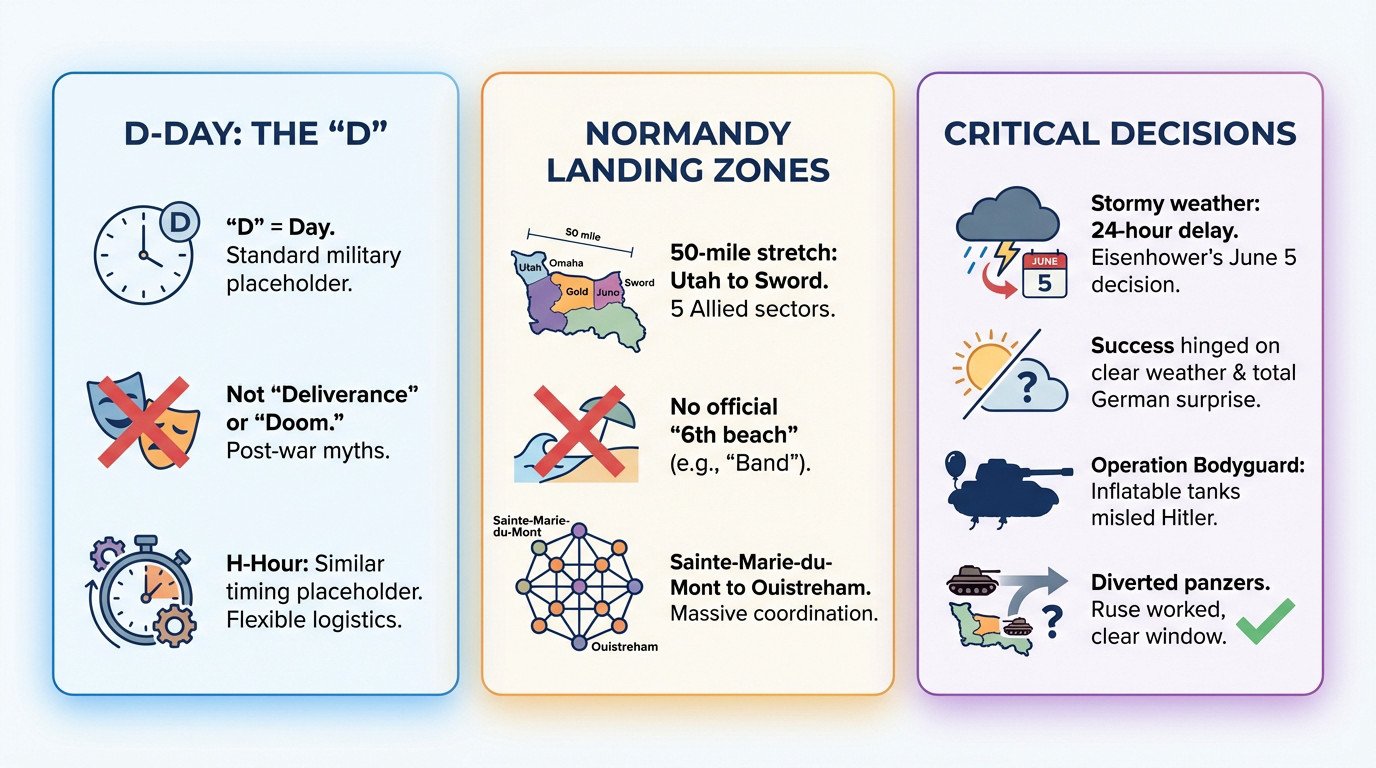
What Does the D in D-Day Actually Mean?
Most people assume the “D” stands for something grand. Actually, it just means “Day.” It served as a standard placeholder for the start of any top-secret military operation.
Forget myths like “Deliverance” or “Doom.” These dramatic interpretations came later. In reality, the military used a dry, bureaucratic shorthand to keep the specific timeline hidden from enemy spies.
H-Hour functioned exactly the same way for specific timing. This system let planners organize every move before the exact date was set. It was a flexible logistics tool requiring military precision to manage thousands of ships.
Mapping the Five Sectors and the 6th Beach Myth
The assault spanned a 50-mile stretch from Utah to Sword. Each sector presented unique geographic hurdles for the Allied forces. Planners carefully carved up the coastline to coordinate the massive attack.
You might hear whispers about a “6th beach” called Band near Ouistreham. While some units landed nearby, it was never an official landing zone for the primary Allied assault plan during June.
This vast front reached from Sainte-Marie-du-Mont to Ouistreham. Managing such a huge area required incredible coordination. Every beach acted as a vital gateway for the liberation of Western Europe from occupation.
Weather Delays and the Operation Bodyguard Deception
Brutal stormy weather forced Eisenhower to delay the invasion by 24 hours. On June 5, he faced a heavy choice. The stakes for the entire free world were incredibly high that morning.
The success of the landings depended on a thin window of manageable weather and the total surprise of the German command.
Then came Operation Bodyguard. This massive deception used inflatable tanks to trick Hitler’s generals. It successfully lured German panzer divisions away from Normandy, focusing their attention on the Pas-de-Calais instead.
The ruse worked. Allied forces seized their brief clear weather window and changed history forever.
American Footprints: The Heavy Price of Utah and Omaha
We now shift our focus from the broad Allied strategy to the intense American experience on the western flank.
Utah Beach and the Daring Airborne Operations
The 101st and 82nd Airborne divisions led the charge. They dropped behind enemy lines in the dark. Their mission was to secure vital causeways.
Look for Sainte-Mère-Église and the paratrooper on the steeple. This town was the first liberated by Americans. It remains a symbol of courage and resilience for us all.
The amphibious success at Utah was remarkable for these normandy landing beaches. Landing slightly off-course actually saved lives. The 4th Infantry Division pushed inland with minimal casualties compared to the bloodbath.
Omaha Beach: Analyzing the Highest Casualty Rates
Picture the deadly bluffs at Omaha. German defenses were nearly untouched by preliminary bombing. Soldiers faced a wall of fire while crossing the open, tidal sands.
The topography was a trap. This natural amphitheater gave Germans the high ground. It was the most most perilous landing of the entire day, testing every soldier’s will to survive.
We must analyze the heavy losses. Over 2,000 Americans fell on these sands. Their ultimate sacrifice eventually secured the vital beachhead for the Allies to advance into France.
Honoring the Fallen at the Normandy American Cemetery
The Colleville-sur-Mer site is breathtaking. It overlooks the very sands of Omaha. The perfectly aligned crosses create a powerful visual impact that stays with you long after you leave.
Look at the 9,387 marble markers. Each Star of David or cross tells a story. The Garden of the Missing honors those never found during the chaotic coastal fighting.
Stay for the Taps ceremony. The evening silence is deeply moving. It offers a moment of reflection for every traveler 🕊️.
Walking here is a solemn duty. Respect the quiet of this hallowed ground.
Gold, Juno, and Sword: The Commonwealth Push
Shift the focus eastward to the British and Canadian sectors where engineering and grit defined the day.
Gold Beach and the Engineering Feat of Arromanches
Behold the massive Mulberry Harbors at Arromanches. These artificial ports were truly engineering marvels. They allowed the continuous flow of supplies and heavy equipment needed for the Allied victory.
The British 50th Division landed here. They moved rapidly inland toward historic Bayeux. Their grit and efficiency proved vital for the breakout from the coast during those first days.
Visit the Arromanches 360 cinema nearby. It provides a visceral 360-degree view of the battle. It is a fantastic starting point for visual learners wanting to understand the scale.
Juno Beach: The Canadian Perspective and the Centre Juno
Honor the 3rd Canadian Infantry Division. They faced heavy sea defenses and hidden mines. Their bravery at Bernières-sur-Mer remains legendary today among locals and visiting history buffs alike.
Explore the Juno Beach Centre. This museum focuses on Canada’s civilian and military contribution. It is a modern, engaging tribute to their massive efforts across the entire Atlantic region.
- The high casualty rate of the first wave.
- The liberation of Courseulles-sur-Mer by brave soldiers.
- North Shore Regiment’s distinct role
Sword Beach and the Liberation of Caen and Bayeux
Follow the British 3rd Division’s landing. Their main objective was the city of Caen. The push was fiercely contested by heavy German armor units stationed just behind the coast.
Meet the French Commandos under Kieffer. They were the only French troops to land on D-Day. They fought hard to reclaim their homeland from the occupying forces that day.
Bayeux was liberated almost without a fight. It became the first major city freed during the entire Normandy campaign.
Explore more of France. Check out things to do in Aix-en-Provence.
Standing Where They Fought: Bunkers and the Atlantic Wall
To understand the scale of the Allied victory at the normandy landing beaches, one must look at the formidable German defenses.
Pointe du Hoc and the Atlantic Wall Defenses
We see the US Army Rangers scaling these vertical 35-meter cliffs. They used ropes and slippery ladders under intense enemy fire. It remains a feat of pure grit.
The ground reveals a haunting lunar landscape today. These massive bomb craters still scar the earth deeply. You can walk through shattered concrete bunkers right now. It shows the sheer violence of the preliminary bombardment.
Neutralizing the heavy guns was the primary strategic goal. These batteries threatened both Omaha and Utah beaches during the initial landing.
Pegasus Bridge and the 6th British Airborne
Major Howard’s men executed a daring glider assault at Pegasus Bridge. They landed with pinpoint accuracy in the dead of night. The team secured the bridge in mere minutes.
We always stop at Café Gondrée nearby. It was the first house in France to be liberated. The family still welcomes visitors today with incredible, firsthand stories.
Holding this bridge protected the vital eastern flank importance. It prevented German reinforcements from reaching the coast quickly. The mission was a tactical masterstroke for the Allies.
The Shadow War: Role of the French Resistance
Sabotage operations were happening everywhere in the shadows. The Resistance cut rail lines and vital phone wires. This blinded the German command during those first chaotic hours.
Local spies provided intelligence gathering that changed everything. They smuggled out detailed maps of the Atlantic Wall. This underground data saved countless Allied lives.
We must acknowledge the extreme civilian risk involved. Helping the Allies meant facing execution by the enemy. Their quiet bravery was indispensable for victory.
Without the French Resistance, the inland movement of Allied troops would have been far slower and deadlier.
Getting to the Coast: Logistics From Paris or Local Hubs
Planning a trip requires more than just historical interest; you need a solid grasp of Normandy’s geography. 🗺️
Day-Tripping From Paris by Train or Organized Tour
Trains beat buses for freedom every time. Taking the train to Bayeux offers more flexibility. Organized tours from Paris are long and exhausting, leaving very little time for actual exploration.
Start your day at 6 AM sharp. A 24-hour round trip is possible but rushed. You risk missing the emotional weight of these sites if you are constantly checking your watch.
Hiring a specialist in Bayeux is better than a generic bus tour. They offer deeper historical context. You get personal stories that are never found in standard guidebooks or group scripts.
Exploring Car-Free From Bayeux, Caen, or Carentan
We recommend Bayeux as the hub. It is centrally located for all sectors. The shuttle services from the station are reliable, connecting you directly to Omaha and Gold beaches without stress.
Mention Caen and Carentan as well. Caen is great for the British sites. Carentan serves as the gateway to Utah beach and offers frequent train access for car-free travelers.
| Hub City | Best For | Transport Options | Vibe |
|---|---|---|---|
| Bayeux | Omaha & Gold | Shuttles/Trains | Historic & Central |
| Caen | Sword & Juno | Bus/Train | Educational & Modern |
| Carentan | Utah Beach | Train/Cycle | Gateway to Marshes |
Sustainable Travel: Cycling the Historic Coast
The “Vélomaritime” connects the main sites beautifully. It is a low-carbon way to see the coast. We love how this route balances physical activity with profound discovery along the sea. 🚲
Biking allows you to feel the terrain. You notice small memorials that cars miss. It is about slowing down to appreciate the scale of the landscape and the coastal defenses.
Towns like Courseulles-sur-Mer have great shops. Electric bikes are a smart choice for these breezy coastal paths.
This approach is eco-friendly and rewarding. It respects the peaceful nature of the region.
Tips for a Meaningful Visit: Etiquette and Offbeat Spots
Beyond the logistics, a visit to Normandy is about respect and finding the right pace for reflection.
Choosing the Best Beach for Your First Visit
We recommend Omaha for drama. It’s the most iconic site for a reason. History buffs should start here to feel the weight of the past immediately. 🎖️
Suggest Utah for airborne fans. The museum there is excellent. It offers a comprehensive look at the paratrooper story through immersive displays and original planes.
Advise on the two-day itinerary. Seeing all five beaches in one day is impossible. Split your trip between the US and Commonwealth sectors for a better experience.
Beach Etiquette and Preserving the Sites of Remembrance
Understand the sand collection rules. It is strictly forbidden to take sand or artifacts. These are protected historical sites where every single grain holds a piece of our history.
Discuss appropriate behavior. Keep voices low at cemeteries. These are places of mourning, not just tourist attractions, so we must show the utmost respect to the fallen.
Provide family and dog advice. Most beaches are dog-friendly in the off-season. Make sure children understand the solemnity of the memorials before you begin your walk together.
Seasonal Events and the D-Day Festival Normandy
Highlight the June commemorations. The D-Day Festival features parades and reenactments. It is a lively but crowded time that requires booking your stay months in advance.
Mention La Cambe. This German cemetery offers a different perspective. It is a stark, somber reminder of the war’s total cost, housing over twenty thousand soldiers.
Suggest shoulder season visits. Spring and autumn are beautiful. You avoid the massive summer crowds while enjoying mild weather and easier access to sites. 🌊
- Military vehicle parades in Bayeux
- fireworks along the coast
- liberty balls in local villages
Exploring the five sectors of the Normandy landing beaches offers a profound connection to our shared history. 🌍 Start your journey from Bayeux soon to beat the crowds and experience these hallowed sites in serene reflection. Walking where heroes stood will forever change how you see the world.
FAQ
What is the actual meaning of the “D” in D-Day?
It is a question we hear all the time! In military parlance, the “D” simply stands for “Day.” It was used as a standard placeholder for the start date of a secret operation when the exact calendar date was still unknown or kept top-secret.
This system allowed planners to organize everything using terms like D+1 or D-1. While legends suggest it means “Deliverance” or “Doom,” the reality was much more technical and bureaucratic. It was all about military precision! 🪖
What are the names and nationalities of the five landing beaches?
The 50-mile stretch of the Normandy coast was divided into five sectors. The Americans took Utah and Omaha, the British landed at Gold and Sword, and the Canadians stormed Juno. It was a massive international effort to reclaim Europe!
Interestingly, the names were chosen to confuse the enemy. The British sectors were named after fish (Goldfish and Swordfish), while the American names were picked randomly by General Bradley, who named them after Utah and Omaha, Nebraska. 🌍
Can we visit the D-Day beaches on a day trip from Paris?
Yes, we can, but be prepared for a very long and moving day! Most organized tours leave Paris around 6 AM and return late in the evening. It is possible but can feel rushed, as you will spend several hours on a bus or train.
For more flexibility, we recommend taking the train from Paris to Bayeux. From there, you can hire a local specialist guide who can offer a much deeper historical context than a generic big-bus tour. It’s a more personal way to experience history! 🚆
Where is the best hub to stay for exploring the landing sites?
We absolutely love Bayeux as a base! It is centrally located, incredibly charming, and was the first major city liberated. It is the perfect middle ground for reaching both the American and British sectors easily.
If you are focusing on the British and Canadian sites, Caen is a fantastic choice. For those who want to be as close as possible to Utah Beach and the airborne sites, Carentan serves as an excellent gateway to the western flank. 🏡
Why did the Allies have to delay the invasion?
The original date was actually set for June 5, 1944. However, a massive storm forced General Eisenhower to make a grueling decision to postpone. The success of the landings depended on a very thin window of manageable weather.
Thanks to a brief improvement in conditions, the “go” was finally given for June 6. This delay actually *helped with the element of surprise*, as German commanders believed the weather was too poor for any Allied attempt! ⛈️
Are we allowed to take sand or souvenirs from the beaches?
While it might be tempting to take a small memento, it is strictly forbidden to collect sand, stones, or artifacts from these beaches. These are protected historical sites and, more importantly, hallowed ground where many gave their lives.
We must respect the solemnity of these locations. Instead of taking physical souvenirs, we recommend visiting the excellent local museums or taking photos to preserve your memories of this powerful experience. Let’s keep these sites intact for future generations! 🙏
What is the best way to get around the sites without a car?
Exploring car-free is totally doable! We suggest using Bayeux as your hub, as many shuttle services run from the train station to the main sites. For a more active and eco-friendly adventure, the “Vélomaritime” cycling route is a beautiful way to see the coast.
Renting an electric bike in towns like Courseulles-sur-Mer allows you to feel the terrain and notice small memorials that cars often miss. It’s a rewarding and respectful way to travel through this historic landscape at your own pace! 🚲