The essential takeaway: Exploring Colmar’s vineyards means choosing between the ease of guided tours and the adventure of solo travel. This choice unlocks a unique journey along the Alsace Wine Route, blending tastings of aromatic Gewürztraminer with visits to fairytale villages like Eguisheim. Whether by van or public transport, the experience guarantees an authentic connection with passionate winemakers and the region’s rich, centuries-old heritage.
Are you struggling to decide between the absolute freedom of a solo road trip and the relaxing simplicity of an organized excursion for your upcoming Alsatian getaway? This curated guide to colmar wine tours helps you navigate the possibilities, ensuring you find the ideal formula to explore the famous Wine Route without any planning stress. Prepare to unlock the secrets of biodynamic viticulture, spot the most charming half-timbered villages like Eguisheim, and savor authentic moments with passionate local winemakers who truly pour their heart into every glass.
Choosing Your Colmar Wine Tour: Organized or Independent?
You are standing at a crossroads in the heart of Alsace, and the choice isn’t just about logistics; it’s about the vibe you need right now. One path offers a seamless, chauffeured experience where you don’t lift a finger, while the other promises the thrill of getting lost in the vines on your own terms. Let’s figure out which path fits your travel DNA.
The Case for Guided Tours: Simplicity and Expertise
Let’s be honest, sometimes you just want to switch off completely. Organized tours are the ultimate “no-headache” solution where a van picks you up, tastings are pre-booked, and you never have to worry about navigating winding roads after a few glasses.
Then there is the human element of having a local expert by your side. They decode the region’s history and explain the wine without boring technical jargon, offering a cultural immersion you simply cannot replicate alone.
You have options regarding the intensity of the experience, too. Pick a half-day sprint to get a quick flavor, or commit to a full-day exploration that combines cellar visits with stunning stops in villages like Eguisheim.
The Freedom of Going Solo: Crafting Your Own Adventure
If you hate sticking to a rigid schedule, going solo is your best move. It offers total flexibility, allowing you to linger in a village that steals your heart or stumble upon a tiny, family-run cellar that doesn’t appear on maps.
But here is the catch: it demands real homework. You need to master the Kut’zig bus schedule or check winery opening hours yourself, making it a more adventurous approach that rewards the prepared.
This path often feels more authentic and personal. You might chat with winemakers who don’t work with big operators, creating a unique memory.
Surprisingly, this is often the best bet even for travelers without a car. With the “hop-on hop-off” bus system starting at the Colmar station, the vineyards are accessible if you plan ahead.
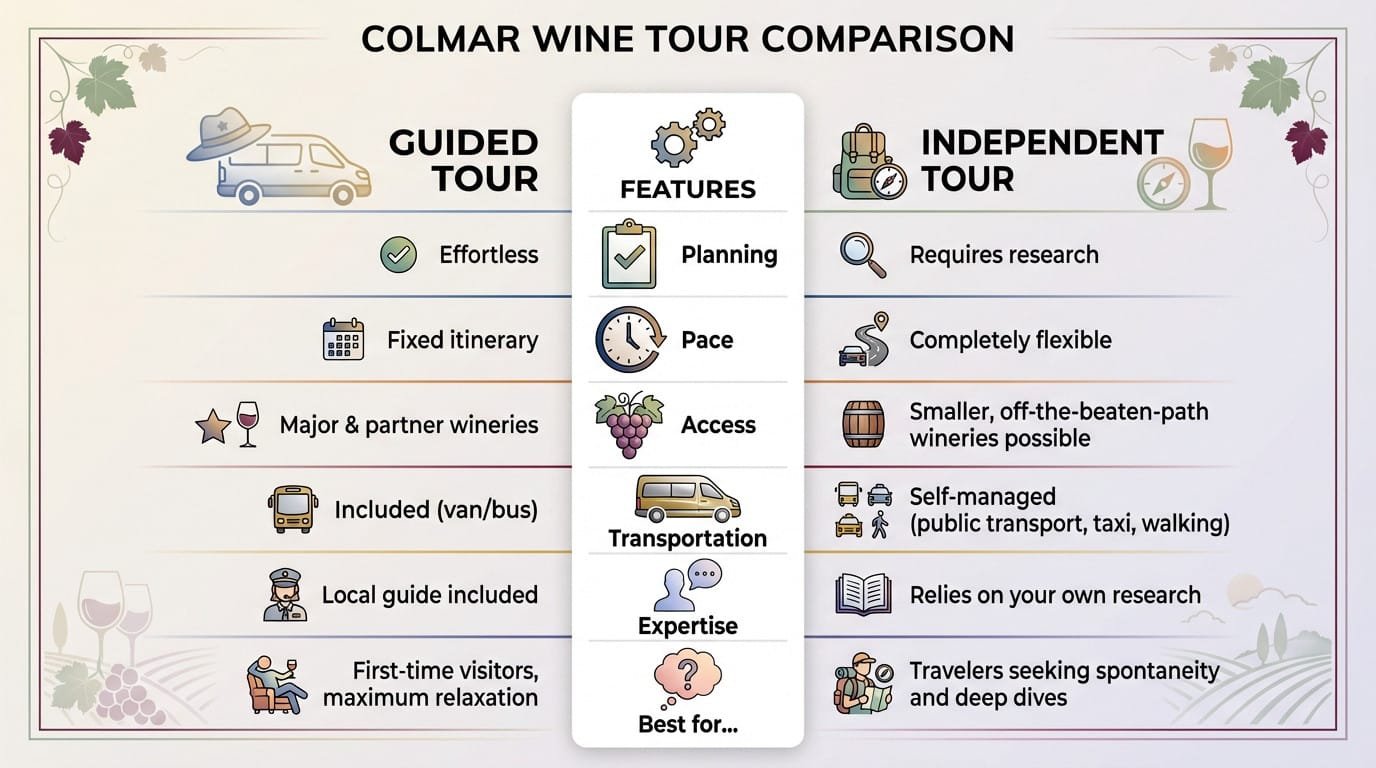
A Quick Comparison: Which Tour Style is Right for You?
Stop guessing and look at the facts. This breakdown cuts through the noise to help you decide in seconds based on your actual needs.
| Feature | Guided Tour | Independent Tour |
|---|---|---|
| Planning | Effortless | Requires research |
| Pace | Fixed itinerary | Completely flexible |
| Access | Major & partner wineries | Smaller, off-the-beaten-path wineries possible |
| Transportation | Included (van/bus) | Self-managed (public transport, taxi, walking) |
| Expertise | Local guide included | Relies on your own research |
| Best for… | First-time visitors, maximum relaxation | Travelers seeking spontaneity and deep dives |
Honestly, there is no wrong turn here. It really comes down to your mood: do you crave comfort or adventure? Either way, the glass of Gewurztraminer waiting for you is excellent.
What to Expect From a Colmar Wine Tour Experience
Once you have sorted out the type of excursion you want, the real fun begins. Here is what you can genuinely expect from the day, and trust me, it involves much more than just glass swirling.
More Than Wine: The Alsace Wine Route Villages
Many assume a Colmar wine tour is solely about the drink. That is missing the point. You are signing up for a full sightseeing experience where the Route des Vins d’Alsace reveals its postcard scenery. The wine and the landscape are inseparable here.
You will hit the iconic spots that everyone talks about. Eguisheim charms visitors instantly with its unique streets built in concentric circles. Then there is Riquewihr, often cited as one of the most beautiful villages in France.
But keep your eyes open for gems like Kaysersberg and Turckheim. Each village boasts its own mood, featuring colorful half-timbered houses and medieval ramparts. It is not just a drive; it is an immersion into a living history book.
The Tasting Experience: Riesling, Gewürztraminer, and Beyond
Let’s demystify the wine tasting part right now. It is not an exam you need to study for. Think of it as a sensory discovery that is totally accessible, whether you are a novice or a connoisseur.
You will quickly meet the local stars. Riesling is the dry, mineral backbone of the region. Gewürztraminer is the opposite: exuberant, aromatic, and bursting with flavor. These are the two pillars you cannot miss.
- Key Alsatian grape varieties you’ll likely encounter:
- Pinot Blanc: a versatile and refreshing white.
- Sylvaner: light and thirst-quenching, perfect for a start.
- Pinot Gris: richer and more full-bodied, often with smoky notes.
- Pinot Noir: the only red grape, producing light and fruity wines.
Your session often starts with Crémant d’Alsace. This excellent local sparkling wine wakes up the palate before you move to the still whites.
Visiting the Cellars: A Glimpse Into History
A cellar visit feels like stepping into a time capsule. You stand amongst massive century-old oak foudres that have witnessed the estate’s family history. It grounds the whole experience in reality.
The ambiance is distinct. You can smell the damp wood and feel the cool air that protects the vintage. This is where the wine ages and where the winemaker shares their craft.
The goal isn’t to give you a technical chemistry lesson. It is about grasping the passion and hard work behind every bottle, from the vine to your glass.
Exploring Without a Car: The Independent Traveler’s Playbook
Using Public Transport From Colmar
Forget the rental car headache; you absolutely do not need one here. The Fluo Grand Est bus network actually serves many key spots along the Wine Route directly from Colmar. It is a surprisingly effective way to travel. You simply hop aboard.
But here is the catch: always verify the schedules before you leave. Frequency is often limited, particularly on weekends or outside peak summer months. Getting stranded is not part of the plan.
While the TER train is an option for larger towns like Turckheim, the bus remains king for reaching the tiniest villages. It gets you right into the heart of the action. Trains simply cannot compete there.
Wineries Within Walking Distance or a Short Bus Ride
Actually, you do not even need to leave Colmar to start tasting. The city center itself hides legitimate winemaking estates that are completely accessible on foot. No transport is required at all.
Look at Domaine Martin Jund, a family-run organic estate located right on Rue de l’Ange. It offers a deeply authentic experience without forcing you to travel anywhere. You discover their philosophy of “reasoned agriculture” firsthand. It feels incredibly personal.
The beauty of Alsace is that you can find world-class wineries right in the city center, offering a genuine taste of the region without any travel hassle.
For nearby gems like Eguisheim, a quick bus ride or a motivated bike ride unlocks everything. You suddenly have access to dozens of traditional cellars just minutes away. The logistics are surprisingly simple.
Tips for Spontaneous Tastings at Family Wineries
Here is a little secret: many small family structures genuinely love welcoming spontaneous visitors. Keep your eyes peeled for signs reading “Dégustation – Vente” or “Caveau ouvert” at village entrances. These often hide the best encounters. Do not hesitate to knock.
Make sure you always keep some cash in your pocket. While many places take cards, smaller growers sometimes only accept cash for a few bottles. Missing out on a rare vintage hurts.
If possible, give them a quick ring before you arrive, especially for small groups. A simple phone call ensures the winemaker is actually available to host you. It guarantees a truly personal moment.
The Alsatian Wine Culture: A Unique Heritage
Beyond the scenic landscapes and the tastings, understanding Alsace wine means touching the region’s soul and its turbulent history.
A Story of French and German Influences
Alsace has spent centuries bouncing between France and Germany, and frankly, you can taste this tug-of-war in every glass. It is not just history; it is a deep cultural duality that shapes the region’s identity, creating a distinct hybrid style.
Look at the grapes: they are undeniably Germanic, with stars like Riesling and Gewürztraminer dominating the local vineyards.
Yet, the winemaking is strictly French: dry wines built for gastronomy, fermented fully, and served in that iconic, slender “flûte d’Alsace” bottle.
The Importance of Terroir and Family Domains
Here, “terroir” isn’t just a buzzword; it is practically a religion. It means the wine’s character comes directly from the specific soil, climate, and unique spot where it was born.
Forget the massive corporate châteaux you see in Bordeaux. Alsace is a patchwork of small plots run by family domains, passed down through generations of stubborn, passionate artisans.
This structure allows for a deeply personal touch. Since every winemaker interprets their specific patch of earth differently, the sheer diversity of wines you find here is truly incredible.
A Pioneer in Biodynamic Winemaking
Alsace didn’t wait for sustainability to become a trend. The region is a true pioneer in organic and biodynamic viticulture, with growers rejecting chemicals decades ago to protect their land and their health.
Giants like Domaine Zind-Humbrecht proved to the world that this method produces superior, world-class wines.
For these growers, it is the only way to make a wine that truly speaks of its origin. It is a non-negotiable commitment to authentic quality and long-term durability.
Planning Your Visit: Practical Tips for a Perfect Trip
Best Time to Visit for Wine Tours
Honestly, if you want the full postcard experience, aim for May to October. The weather is actually cooperative, the vines are that vibrant green you see on Instagram, and every single village cellar is wide open for business.
But there is a sweet spot: September and October. This is harvest (vendanges) time. The energy is totally electric, though you might find winemakers a bit busier than usual.
Don’t write off winter, though. The Christmas markets change the game entirely. It’s magical, quieter in the cellars, and the perfect excuse to swap crisp Riesling for warm, spiced wine.
Booking in Advance vs. Spontaneity
Here is the deal with logistics: book online if you want a structured tour, especially in summer. It’s the only way to guarantee you aren’t left standing outside the gate.
For those specific, high-reputation estates you have read about, reservations are usually mandatory. A quick email or phone call a few days prior is all it takes to secure entry.
That said, leave some gaps in your schedule. Seriously. Getting a little lost on the wine route often leads to the best, unplanned tastings in tiny, family-run cellars.
Accessibility for Visitors with Disabilities
Let’s be real about accessibility here. Alsace is beautiful, but those charming medieval villages with their uneven cobblestones and steep, ancient cellars can be a genuine nightmare for anyone with reduced mobility. You need to know what to expect.
While the historic charm of Alsace is undeniable, it’s wise to inquire directly with wineries about accessibility, as many modern tasting rooms are well-equipped for all visitors.
Do not let that stop you, though. Contact the domains directly before you go. You will find that many have renovated their tasting rooms to be surprisingly modern and welcoming.
In my experience, private tours are often the smartest move. Guides can tailor the entire itinerary to avoid obstacles and use vehicles that make the whole day smooth and comfortable.
Beyond the Bottle: Making the Most of Your Alsatian Experience
A trip along the Wine Route is about more than just what is in your glass. Here is how to flesh out the journey for a memory that actually sticks.
Pairing Alsatian Wines with Local Food
Let’s be honest: Alsatian wine without food is like a sentence without a verb. The region’s gastronomy is hearty, savory, and built specifically to match these bottles. Pairing here isn’t about snobbery; it is just pure, delicious common sense.
- Choucroute garnie with a dry Riesling.
- Tarte flambée (Flammekueche) with a fresh Pinot Blanc.
- Munster cheese with a powerful Gewürztraminer.
- Kougelhopf (sweet version) with a late-harvest Vendanges Tardives.
The best place to test this theory? “winstub.” These traditional taverns are where the real magic happens
The “Four Wonders of Alsace”: A Must-Do Day Trip
You might have heard whispers about the “4 Wonders of Alsace.” It is not just marketing fluff; this circuit groups some of the most visually stunning spots you will ever see.
We are talking about a heavy-hitting lineup: Eguisheim, Kaysersberg, Riquewihr, and Hunawihr. Most day tours zero in on this specific route because it hits every high note without wasting time.
If you are short on time, this is your cheat code. You get the architecture, the history, and the wine stops without spending hours stuck in a car.
Responsible Tasting and Getting Back Safely
Let’s address the elephant in the room: alcohol. Tastings stack up faster than you think. To actually remember the beauty of the region, moderation is your absolute best friend.
Use the spittoons. Seriously. It is not rude; it is what the pros do. It shows the winemaker you are there to taste the craft, not just to get buzzed.
Finally, figure out your ride home before you sip. Organized tours or the local Kutzig bus are lifesavers here. Never, ever get behind the wheel after a session.
Ready to explore the Alsace Wine Route? Whether you choose the comfort of a guided tour or the freedom of a solo adventure, magical moments await.
Savor the unique wines, soak up the village charm, and enjoy every sip. It’s time to create your own authentic memories in Colmar! 🥂
FAQ
Is it better to choose a guided tour or visit wineries on my own?
It really depends on the kind of experience you are looking for! If you want a stress-free day where transportation is handled and you get expert storytelling, a guided tour is fantastic. It lets you fully relax and enjoy the tastings without worrying about the logistics.
However, if you love the freedom to linger in a charming village or stumble upon a hidden gem at your own pace, going solo is incredibly rewarding. It takes a bit more planning, but the sense of discovery and the chance to chat one-on-one with winemakers is worth it.
Can I visit wineries in Colmar without a car?
Absolutely, and it’s actually quite easy! You don’t even need to leave the city center to find authentic spots. For instance, Domaine Martin Jund is a wonderful family-run, organic winery located right on Rue de l’Ange in Colmar. It’s perfect for a tasting without any travel hassle.
For exploring nearby villages, the local public transport network (Fluo Grand Est) is very reliable. You can hop on a bus to reach stunning spots like Eguisheim or Turckheim. It’s a great eco-friendly way to see the region while keeping everyone safe after a few glasses of wine. 🚌
What are the “must-visit” villages near Colmar for wine lovers?
The area is packed with fairytale spots, but a few stand out. Eguisheim is incredibly picturesque. Riquewihr and Kaysersberg are also iconic stops that combine medieval history with exceptional cellars.
Many travelers aim for the “Four Wonders of Alsace” circuit, which includes these villages plus Hunawihr. Each has a unique vibe, so whether you are on a tour or exploring independently, you are guaranteed some beautiful scenery and great photos. ✨
What types of wine should I expect to taste in Alsace?
Prepare your palate for some of the world’s best white wines! The two stars you will see everywhere are Riesling, which is dry and elegant, and Gewürztraminer, which is famous for its aromatic, spicy, and floral notes. They are the heart of the region.
You will also likely try Pinot Gris, which is richer, and Pinot Blanc, which is refreshing and versatile. If you prefer bubbles, Crémant d’Alsace is a sparkling delight often served at the start of a tasting. It’s a sensory journey through the local terroir!
Do I need to book wine tastings in advance?
For organized tours, I definitely recommend booking online in advance, especially if you are visiting during the busy summer season or harvest time (September-October). It guarantees your spot and peace of mind.
For independent visits to smaller family domains, a quick phone call or email a few days before is a polite gesture to ensure the winemaker is available. However, if you see a sign saying “Dégustation – Vente,” feel free to be spontaneous and walk in!
What food pairs best with Colmar wines?
The local gastronomy is generous and pairs naturally with the wines. A classic combination is a crisp Pinot Blanc with a Tarte Flambée (Flammekueche)—it’s simple, delicious, and perfect for sharing. It’s the ultimate comfort food experience.
For something more adventurous, try pairing a powerful Gewürztraminer with local Munster cheese; the strong flavors balance each other beautifully. Don’t forget to try these pairings in a traditional winstub for the most authentic atmosphere. 🥨